
Cutting Tool Selection Guide
Carbide CNC Turning Inserts: How to Choose by Material, Chipbreaker and Coating
How distributors choose carbide CNC turning inserts by ISO material group — P, M, K, N, S, H — with chipbreaker, coating and grade guidance for steel, stainless and hardened steel.
Why the ISO material group comes first
A turning insert does not fail in the abstract — it fails on a specific material. The fastest way for a distributor or importer to narrow a carbide CNC turning insert range is by ISO group, then by operation (roughing, medium turning, finishing), then by chipbreaker and coating. CutStars' turning range is organised this way: P for steels, M for stainless steels, K for cast irons, N for non-ferrous metals, S for heat-resistant / superalloys, and H for hardened steels.
P — steels: the workhorse range
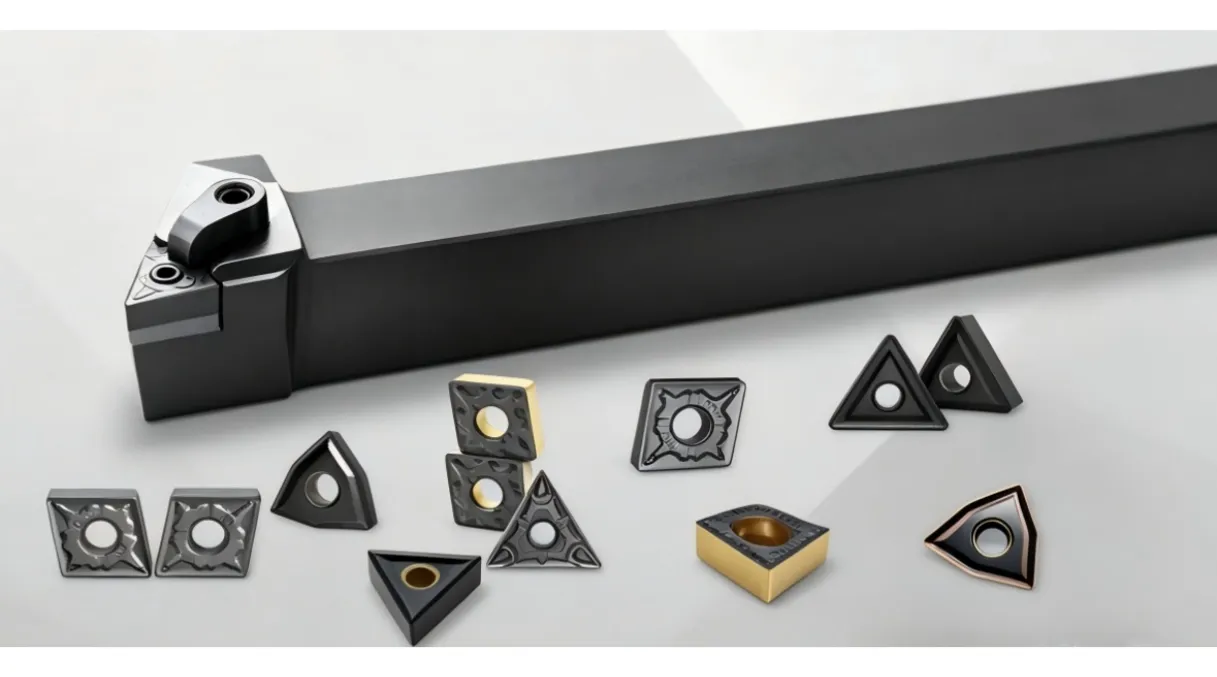
For P-group steels, CutStars lists a universal turning insert for roughing to semi-finishing, with a CVD composite coating (TiCN + Al2O3 + TiN) and a stress-relief process, designed for good deformation resistance and edge strength. A separate heavy-duty P insert uses the same TiCN + Al2O3 + TiN CVD coating on a high-hardness substrate, for roughing, semi-finishing, heavy-duty turning and boring. If a customer is turning carbon and alloy steels at medium to finishing passes, the high-performance turning insert with GM & TF chipbreakers is the matching option: it is specified for medium and finish turning of carbon steel, alloy steel, stainless steel and heat-resistant alloys, with a new PVD coating for long tool life and resistance to edge chipping, and is paired with a high-performance turning holder.
M — stainless steels: wear, heat and built-up edge
Stainless steel (201, 304, 316, 430, 630) is where distributors most often hear about poor tool life. CutStars' M-group external and internal turning inserts are specified for those grades, with wear and high-temperature resistance, toughness, anti-adhesion and anti-wear performance, a sharp cutting edge and smooth chip evacuation. The GM & TF chipbreaker insert above also covers stainless steel in medium and finish turning. For a buyer, the practical question is not “which grade?” in isolation — it is whether the insert holds its edge through a full batch without built-up edge forcing an early change.
K — cast irons: thick coating, interrupted cuts
For grey and ductile cast iron, the K-group turning insert uses a thick CVD coating with a stress-relief process to extend tool life, with the coating toughened for wet, interrupted machining of grey and ductile iron. That interrupted-cut detail matters: a distributor selling into foundry or automotive cast-iron work should check it explicitly, rather than recommending a general-purpose P insert.
N, S and H — the specialist groups
- N (non-ferrous): inserts with a clean surface, sharp edge and good corrosion resistance, for non-ferrous turning and forming.
- S (heat-resistant / superalloys): high-speed turning inserts that retain hardness and strength at high temperature, with a clean surface for finish turning, low cutting resistance and long life.
- H (hardened steel, HRC 55–65): advanced inserts on a high-strength substrate with a nano PVD coating (strong adhesion, high-temperature resistance), for semi-finishing and finishing of external and internal turning, with good workpiece surface quality. This HRC 55–65 range is a useful qualifier in a quote — below it, a P or M insert is usually the right conversation; above it, the H insert is.
Chipbreakers: GM & TF, and what they are for
The high-performance turning insert range is offered with GM & TF chipbreakers for medium and finish turning. When a customer reports long, stringy chips or poor chip control in medium turning, the chipbreaker — not just the grade — is the first thing to check. The same insert family is specified for carbon steel, alloy steel, stainless steel and heat-resistant alloys, so one stocked family can cover several of a distributor's customers, with the holder matched to it.
Coatings in plain terms
Two coating families appear across the range, and they point to different jobs:
- CVD (TiCN + Al2O3 + TiN) on the P and K inserts — thick, wear-resistant, suited to steel and cast-iron roughing / semi-finishing, including interrupted cuts.
- PVD (new PVD on the GM & TF inserts; nano PVD on the H inserts) — for medium / finish turning and hardened steel, where edge sharpness, adhesion and resistance to chipping matter more than coating thickness alone.
A distributor does not need to memorise the chemistry. The buying question is: roughing or finishing, continuous or interrupted, and which ISO group?
A short selection checklist for a quote
Ask the customer for these five facts and the insert choice narrows quickly:
- Workpiece material and ISO group (P / M / K / N / S / H) — and, for stainless, the grade (e.g. 304 / 316).
- Operation: roughing, medium turning, or finishing — and internal or external turning.
- Hardness, if known (e.g. HRC 55–65 points to the H range).
- Continuous or interrupted cut, wet or dry.
- Chip control problem, if any — long chips, built-up edge, or edge chipping.
With those five, CutStars can confirm grade, chipbreaker (GM / TF) and holder from the stocked range.
What to ask CutStars for
Distributors and importers can request the turning-insert catalogue / parameter table, the GM & TF chipbreaker options, and the matching holders. Enquiries are accepted by WhatsApp, the website form and email (info@cutstars.com).