
Sep 16, 2026Cutting Tool Selection Guide
# How to Choose the Right Solid Carbide End Mill: A Practical Selection Guide
This guide explains the key factors used to select solid carbide end mills for different applications, helping you evaluate both standard and custom OEM tools based on performance rather than marketin
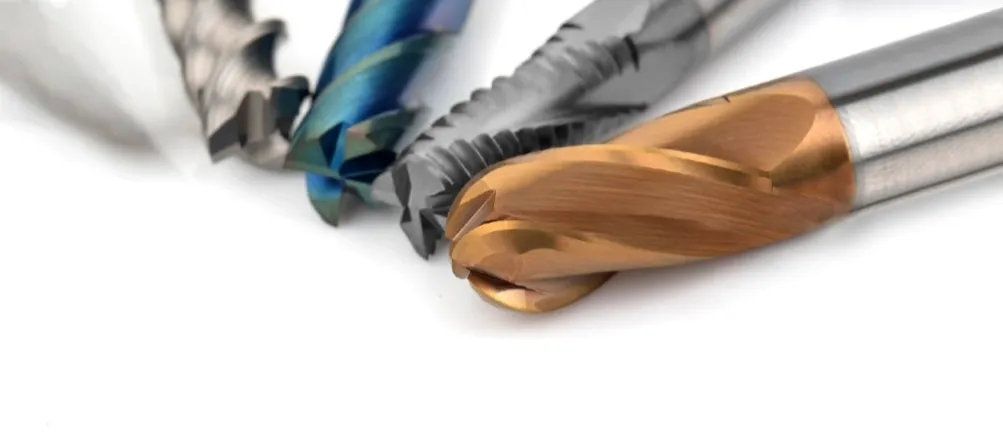
How to Choose the Right Solid Carbide End Mill: A Practical Selection Guide
Carbide grade, flute count, helix angle, coating and milling strategy — what actually matters when you select an end mill, explained from a manufacturing and sourcing perspective.
Choosing a solid carbide end mill looks simple on a product page: diameter, flute count, coating, price. In real machining, however, tool performance is decided long before the first chip is cut — by the carbide grade, the geometry hidden inside the flute, and how well the tool design matches your workpiece material and machine conditions.
At CutStars, we source solid carbide end mills and other carbide cutting tools from qualified Chinese manufacturers, and these are exactly the criteria our team uses to match a product to an application.
1. Start With the Carbide Grade, Not the Catalog Page
A solid carbide end mill is made from tungsten carbide (WC) grains bonded with cobalt (Co), often with rare-earth additives. Two variables dominate performance:
Cobalt content: toughness vs. hardness
For general-purpose end mills, cobalt content typically falls between 8% and 12%, with 10% Co being the industry mainstream — the same baseline used by most major global brands.
- Higher Co content → lower hardness, but better impact resistance. This suits roughing, heavy metal removal and unstable machining conditions.
- Lower Co content → higher hardness and wear resistance, but less toughness. This suits finishing and highly stable setups.
WC grain size: fine is not automatically better
- Finer WC grain (e.g. sub-micron) → higher hardness and better wear resistance, ideal for finishing and high surface-quality work.
- Coarser WC grain → better transverse rupture strength and impact resistance, ideal for roughing.
Here is the practical insight most buyers miss: the mainstream premium end mills on the market — from Sandvik, Guhring, Walter, Iscar, Kyocera and similar brands — are built on roughly 10% Co with ~0.8 µm grain size. This combination covers the vast majority of milling applications. Ultra-fine grades of 0.5 µm, 0.3 µm and below are reserved for specific high-hardness applications, because ultra-fine powders are significantly harder to press, sinter, control and coat consistently.
Selection tip: Don't pay a premium for grain size you don't need. Match the grade to the application: toughness for roughing, hardness for finishing, and the proven 10% Co / 0.8 µm baseline for general-purpose work.
2. Match the Tool to the Workpiece Material (ISO Groups)
Workpiece material is the single biggest factor in end mill selection. The ISO classification system groups materials into six categories:
ISO Group | Material Family | Selection Focus |
P | Steels (non-alloy, alloy) | Balanced grade; chip control is usually manageable |
M | Stainless steels | Sharp edge, resistance to work hardening and built-up edge |
K | Cast irons (GCI, NCI, CGI) | Wear-resistant grade, thermal control |
N | Non-ferrous (aluminum, copper) | Polished uncoated or DLC-coated edges, large gullets |
S | Heat-resistant superalloys | Sharp but strong edges, heat-resistant coating, careful edge prep |
H | Hardened steel (45–68 HRC) | Fine-grain ultra-hard grade, negative-ish edge, rigid setup |
The same diameter end mill can be three completely different tools depending on the material group it was designed for. When you request a quotation or an OEM build, always state the workpiece material, hardness and machining condition — not just the tool dimensions.
3. Flute Count: Chip Space vs. Strength
The number of flutes controls the balance between chip evacuation capacity and tool rigidity:
- 2 flutes — largest chip space, best chip evacuation; the default choice for slotting and gummy materials such as aluminum; limited core diameter.
- 3 flutes — chip space close to a 2-flute tool with better rigidity and a better finished surface; a strong compromise for stainless steels and aluminum alloys.
- 4 flutes — smaller gullets but a stronger core and superior surface finish; the versatile workhorse for steels and side milling.
- 5+ flutes — maximum finish quality and feed-per-tooth efficiency with small chip loads; best for high-speed finishing and adaptive toolpaths, with reduced chip clearance.
Selection tip: Slotting with full-width engagement? Prioritize chip space (2–3 flutes). Profiling and finishing in stable conditions? More flutes will buy you tool life and surface quality.
4. Helix Angle: The Hidden Driver of Forces and Finish
The helix angle — the angle between the cutting edge and the tool axis — redistributes cutting forces between the axial and radial directions:
- 30° helix — the most common general-purpose design. Large chip space, low axial pull-out force, suitable for the widest range of jobs including rough slotting.
- 45–50° helix — balances axial and radial forces, reduces radial deflection and tool vibration, delivers good surface quality with reliable chip evacuation. A strong choice for milling walls and shoulders.
- 60° helix — high shear, excellent surface finish and verticality on walls; designed mainly for finishing, where the higher pull-out risk is managed by reduced engagement.
As a rule of thumb: higher helix angles push chips upward and improve wall finish, while lower helix angles give you chip space and edge strength for aggressive roughing. For thin-wall parts, a higher helix also reduces radial force — which directly reduces part deflection and chatter.
5. Geometry Details That Separate Good Tools From Cheap Ones
Two end mills can share identical dimensions and price tiers and still perform completely differently. Ask about:
- Core thickness (web) — the backbone of the tool. A thicker core improves rigidity but reduces chip space; good designs taper the core along the flute length.
- Rake angle — sharper positive rake cuts easier and suits stainless steels and titanium; a stronger (less positive) edge survives interrupted cuts and hardened materials.
- G flute geometry / chip gullet shape — an optimized gullet forms and directs the chip without obstacles; poorly designed gullets re-cut chips and drive temperature up. Most cutting heat concentrates in the chip, so chip-forming efficiency directly controls tool temperature.
- Edge preparation (honing) — every ground edge carries microscopic defects (typically 0.01–0.05 mm chips and sawtooth visible under 100× magnification). Proper edge honing removes these defects and stabilizes the edge before coating. This is one of the biggest quality gaps between top-tier and budget manufacturers.
- Unequal flute spacing / variable helix — breaks up harmonic chatter and improves stability in long-overhang and thin-wall machining.
- Margin and back clearance — control rubbing, burnishing and radial pressure, especially critical in stainless and superalloy machining.
When evaluating a supplier — or comparing a quote against a premium brand — these are the questions that reveal actual manufacturing capability.
6. Coating: Match the Coating to the Job
Modern solid carbide end mills are almost exclusively coated by PVD processes (with CVD diamond coatings reserved for graphite and highly abrasive composite materials). Key selection points:
- There is no universal coating. Steels, stainless steels and cast irons each favor different coating chemistries (TiAlN-family, AlCrN-family, and specialized multilayers).
- Some coatings perform best dry; others demand strong coolant supply. Applying a coating outside its intended cooling regime can shorten tool life dramatically.
- Coating technology moves fast. The coating is often a larger differentiator between tool generations than the carbide substrate itself — one more reason to work with manufacturers who invest in modern coating lines and proper edge preparation before coating.
7. Don't Fight the Toolpath: Milling Strategy Matters
Even a perfectly selected end mill underperforms with the wrong milling strategy:
- Climb milling (down milling) is the default for carbide tools — it minimizes rubbing and work hardening.
- Arc-in tool entry (rolling into the cut) protects the edge from the full-thickness impact of straight plunging.
- Trochoidal / adaptive milling keeps chip thickness constant with light radial engagement and full-depth axial passes — the standard approach for hardened steels and unstable setups.
- High-feed milling uses small depths and very high feeds to move heat into the chip rather than the tool and workpiece.
A supplier who can discuss toolpaths — not just deliver boxes — is a supplier who understands the products they sell.
Frequently Asked Questions
What is the best carbide grade for general-purpose end mills? Roughly 10% cobalt with ~0.8 µm WC grain size is the proven mainstream for general milling. Increase Co or grain size for toughness in roughing; go finer-grain and lower-Co for hardened-steel finishing.
How many flutes should my end mill have? Use 2–3 flutes for slotting and soft or gummy materials, 4 flutes for versatile steel milling and finishing, and 5+ flutes for high-speed adaptive and finishing passes where chip load per tooth is small.
Does a higher helix angle always mean better finish? Generally yes for wall finish, because the higher shear angle reduces radial force — but it reduces chip space and increases pull-out risk, so high-helix tools are best reserved for finishing and light-engagement toolpaths.
Why do two end mills with the same dimensions perform differently? Grade, core thickness, rake angle, gullet design, edge preparation and coating can all differ. Dimensions are the least informative part of an end mill specification.
Talk to a Carbide Sourcing Specialist
Need help matching an end mill to your application — or building your own branded end mill line? CutStars sources solid carbide end mills, modular milling systems and custom carbide components from qualified Chinese manufacturers, with technical matching, sampling and quality control managed through one point of contact.
[Get a Quote] · [Send Us Your Drawing or Spec]