
Cutting Tool Selection Guide
Solid Carbide End Mills: Choosing by Material — Hardened Steel, Stainless, Aluminium and Superalloys
How distributors choose solid carbide end mills by material — hardened steel, stainless, aluminium and superalloys — with a real stainless dynamic-milling test: 50 pieces vs 40.
Why the material comes first
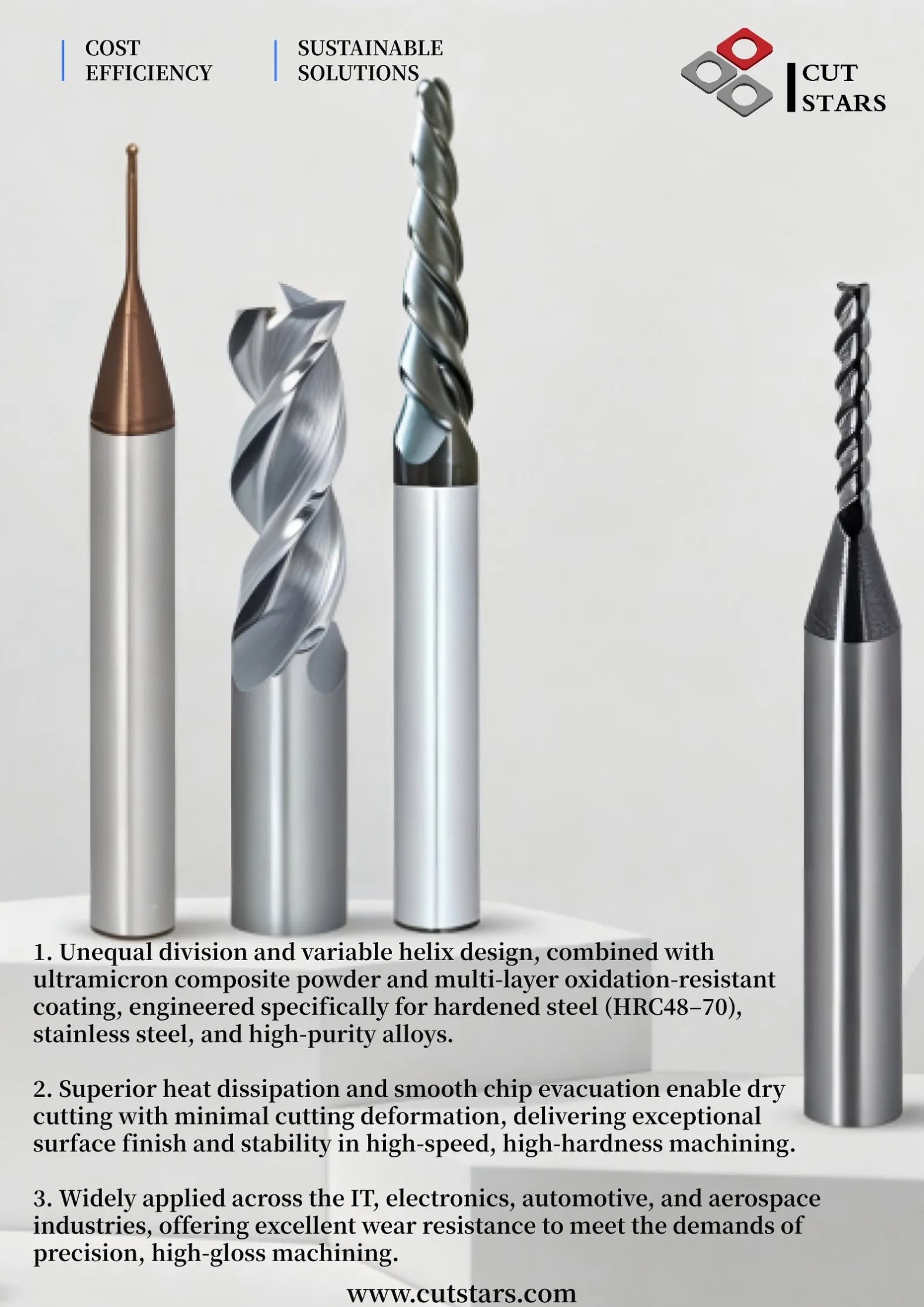
A solid carbide end mill does not fail in the abstract — it fails on a specific material, at a specific hardness, with a specific chip problem. The fastest way for a distributor or importer to narrow the range is by workpiece material, then by operation (roughing, finishing, or both in one tool), then by geometry (unequal pitch, ball nose, flute design) and coating. CutStars' solid carbide end mill range is organised this way, and this guide follows it.
Hardened steel (HRC 48–70): precision and dry cutting
For hardened steel, CutStars lists a high-speed, high-hardness end mill specified for HRC 48–70: high precision (±0.005 mm), ultra-fine grain compound powder, a multi-layer oxidation-resistant coating with excellent wear resistance, and dry cutting with an extreme finish. A separate high-hardness end mill covers workpieces below HRC 65, with smooth, stable chip removal and a bright, clean finish in high-speed, high-hardness machining. The buying question here is the hardness number: below HRC 65 the high-hardness range is the conversation; HRC 48–70 points to the high-speed, high-hardness range, and dry cutting is a real option to confirm for the job.
Stainless steel: roughing and finishing in one tool — with a real test
Stainless steel is where distributors most often hear about poor tool life and poor chip control. CutStars' stainless end mill is designed for roughing and finishing in one tool: unequal-pitch, unequal-helix design with a stainless-specific coating, for excellent heat dissipation, chip removal and stability.
That is not just a catalogue claim. In a CutStars test on a stainless valve block (1Cr17Ni, HB 230–260, Mazak horizontal machining centre, external cooling), the same job was run at identical parameters — cutting speed 95 m/min, feed 0.18 mm/tooth, radial depth 0.3 mm, axial depth 20 mm, 20 minutes per piece — first with a leading imported brand's D12 R0.5 end mill, then with CutStars' D12 R0.5 end mill (GS1200.12.75.R05). The imported tool ran 40 pieces (800 minutes of tool life); the CutStars tool ran 50 pieces (1,000 minutes) — 25% more pieces at the same parameters. The comparator brand is anonymised here.
Aluminium: wear resistance and a bright finish
For aluminium, CutStars lists a high-efficiency end mill with excellent wear resistance and a bright, high-light finish, applied in IT, electronics, automotive and aerospace work. For a distributor selling into those industries, the practical check is the surface requirement: if the customer needs a bright finish on aluminium parts, this is the range to quote first, rather than a general-purpose end mill.
High-temperature alloys and titanium: heat out, deformation down
For high-temperature alloys and titanium, CutStars lists a dedicated end mill with unequal-pitch, unequal-helix design, excellent heat dissipation and a small cutting-deformation coefficient, for high-purity alloy elements and dense-structure austenitic alloys. A supporting test on GH4169 superalloy (HRC 33) ran CutStars' GS1200.12.50.R05 at 30 m/min with a 60-minute tool life and only 0.03 mm of wear — a useful data point for a distributor quoting superalloy work, though it had no head-to-head comparator, so it is presented as a single-tool result, not a comparison.
Ball nose: mould cavities and curved surfaces
For mould cavities, curved profiles and 3D surfaces, CutStars lists a specialised ball nose end mill: versatile across materials, with a non-equidistant helical flute design to reduce vibration and excellent surface quality. When a customer is finishing a mould cavity, the ball nose — not a square end mill — is the right starting point, and vibration control is the feature to ask about.
A short selection checklist for a quote
Ask the customer for these five facts and the end mill choice narrows quickly:
- Workpiece material and hardness (e.g. hardened steel HRC 48–70, stainless 304/316, aluminium, GH4169).
- Operation: roughing, finishing, or roughing + finishing in one tool — and slotting, shoulder milling or trochoidal milling.
- Surface-finish requirement (e.g. bright finish on aluminium, extreme finish on hardened steel).
- Chip and heat problem, if any — long chips, vibration on curved surfaces, or heat build-up in stainless / superalloys.
- Machine and coolant: dry cutting is specified for the high-hardness range; the stainless test above used external cooling. With those five, CutStars can confirm the end mill family, geometry and coating from the stocked range. For turning jobs on the same materials, see our guide to carbide CNC turning inserts.
What to ask CutStars for
Distributors and importers can request the solid carbide end mill catalogue / parameter table and the matching application guidance. Enquiries are accepted by WhatsApp, the website form and email (info@cutstars.com).